
Industrial PHE
Engineered for Heavy-Duty Thermal Performance Across Demanding Industries
Industrial thermal processes rarely operate under gentle conditions. High pressures, aggressive fluids, wide temperature swings and round-the-clock duty cycles are the norm rather than the exception in sectors like chemical processing, power generation, oil and gas, and heavy manufacturing. Equipment operating in these environments has to be built for endurance first — efficiency and compact footprint are what make a good unit, but survival under stress is what separates a reliable one from a liability.
PHE INDIA™ (Process Engineers And Associates) has been manufacturing Industrial Plate Heat Exchangers since 1995, with a design philosophy centered on withstanding exactly these demanding conditions while still delivering the thermal efficiency that makes plate technology attractive over older shell-and-tube designs. Our Industrial PHEs are used in chemical plants, power stations, HVAC installations, refrigeration systems, marine vessels, textile mills, water treatment facilities and heavy manufacturing operations across India and international markets.
Unlike our food grade range, which is built around hygiene and sanitary compliance, our Industrial PHE line is engineered around a different set of priorities: pressure tolerance, chemical compatibility, thermal cycling endurance and long-term mechanical reliability under continuous heavy load.
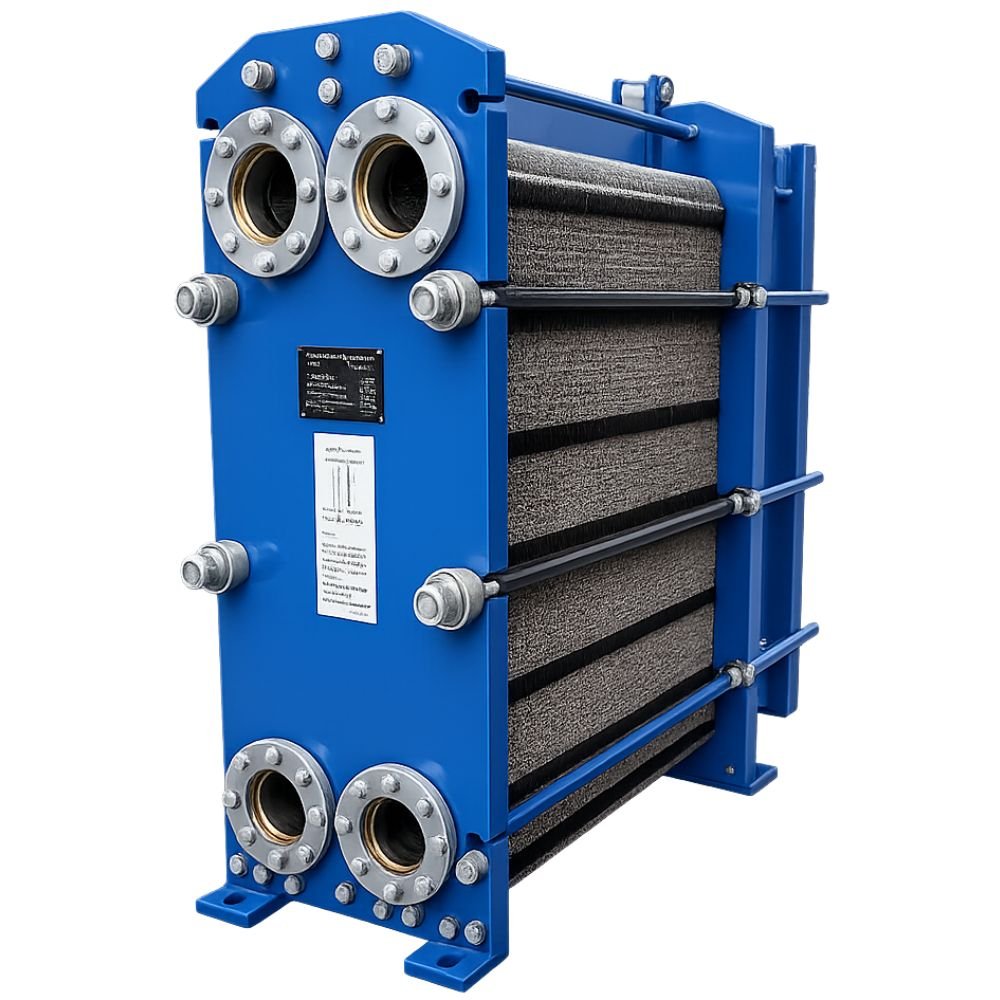
Why Plate Heat Exchangers Outperform Shell & Tube Designs
For decades, shell and tube heat exchangers were the default choice for industrial thermal applications, largely because the technology was well understood and could handle high pressures. Plate heat exchanger technology has since closed that gap and, in most applications, now offers a genuinely superior alternative.
Higher heat transfer coefficients. The corrugated plate surface creates turbulent flow at comparatively low fluid velocities, which dramatically increases the rate of heat transfer per unit of surface area compared to the smooth tube walls of a shell and tube design.
Smaller footprint for equivalent duty. Because plate heat exchangers transfer heat so much more efficiently, a plate unit can often replace a shell and tube exchanger several times its size while handling the same thermal load — a significant advantage in facilities where floor space carries real cost.
Closer approach temperatures. Plate heat exchangers can typically achieve a much tighter temperature approach between hot and cold streams than shell and tube designs, which translates directly into better heat recovery and lower utility consumption.
Easier maintenance access. A plate pack can be opened, inspected and individual plates replaced without needing to pull an entire tube bundle out of a shell casing — a job that in shell and tube systems often requires significant downtime and specialized lifting equipment.
Modular expandability. If process capacity increases down the line, additional plates can often be added to an existing frame rather than requiring a completely new unit — a flexibility shell and tube exchangers simply don’t offer.
Lower fouling in many applications. The turbulent flow pattern across plate surfaces tends to keep particulate and scale from settling as readily as it does along the comparatively still boundary layers inside tube-based designs, though this varies by fluid type and operating conditions.
None of this means shell and tube designs no longer have a place — for certain extremely high-pressure or high-temperature applications, or where fluids contain large solid particulates, they can still be the better fit. But for the large majority of industrial heating, cooling and heat recovery duties, a properly engineered plate heat exchanger delivers better performance in a smaller, more serviceable package.
Material and Gasket Options Built Around Your Process Fluid
One of the defining differences of our Industrial PHE range compared to food grade units is the breadth of material options available, since industrial applications involve a much wider variety of process fluids — from corrosive acids to hydraulic oils to high-temperature process water.
Plate materials. Depending on the fluid chemistry and operating conditions, our Industrial Plate Heat Exchangers are available in SS304, SS316 stainless steel, and titanium plate construction. Titanium plates, in particular, are specified for applications involving seawater, chloride-rich fluids or highly corrosive chemical streams where even SS316 would degrade prematurely.
Gasket materials. We offer a range of elastomer options including EPDM, NBR and Viton, each selected based on the specific chemical compatibility and temperature range required. EPDM performs well across a broad range of water-based and steam applications, NBR is often preferred for oil and hydrocarbon-based fluids, and Viton is typically specified where high temperature resistance combined with chemical resistance to aggressive media is required.
Frame and connection design. Frame construction, plate thickness, port sizing and connection types are all selected to match the pressure rating and flow requirements of your specific process — not standardized to a single configuration regardless of application.
Choosing the wrong plate or gasket material for a given fluid is one of the most common causes of premature failure in industrial heat exchangers, whether through chemical attack on the plate surface or gasket degradation leading to leaks. Our engineering team works through these material selection decisions with clients directly, based on actual process fluid data rather than generic assumptions.
Engineering Approach: Built Around Your Actual Operating Conditions
Every industrial thermal process has its own combination of variables, and a heat exchanger that performs well in one application can be entirely unsuitable in another. Before recommending a configuration, our engineering team works through several key parameters with each client:
Fluid characteristics — viscosity, chemical composition, presence of particulates, corrosiveness, and pH
Operating temperature range — both the required inlet/outlet temperatures and the maximum temperature the unit will be exposed to during upset conditions
Operating and design pressure — including any pressure surges the system might experience during startup, shutdown or process disturbances
Flow rate and expected variation — accounting for peak demand as well as typical operating conditions
Fouling tendency — some process fluids scale or foul plate surfaces more readily than others, which affects plate spacing and cleaning frequency requirements
Available space and installation constraints — particularly relevant in retrofit projects where the exchanger needs to fit into an existing plant layout
This process-first engineering approach — rather than supplying a generic catalogue unit and hoping it fits — is central to how PHE INDIA™ has built long-term relationships with clients across chemical processing, power generation and heavy manufacturing sectors over the past three decades.
Industry Applications
Our Industrial Plate Heat Exchangers are engineered for a wide range of heavy-duty applications, including:
- Hydraulic oil cooling — maintaining stable hydraulic fluid temperatures in industrial machinery and mobile equipment systems
- Gear oil cooling in lubrication systems — protecting gearboxes and rotating equipment from thermal degradation of lubricants
- DM water cooling for induction furnaces — managing the demineralized water cooling circuits critical to induction melting operations
- Quench oil cooling — controlling oil temperature in heat treatment quenching processes to maintain consistent metallurgical results
- Sulphuric acid cooling in anodizing plants — handling highly corrosive process fluids in surface treatment operations
- Wastewater and effluent heat recovery — recovering usable heat from process wastewater streams before discharge or treatment
- Chilled water heat transfer with industrial chillers — supporting process cooling loops across manufacturing facilities
- Degreasing solution heating in automobile paint shops — maintaining pre-treatment bath temperatures for consistent paint adhesion
- Hot water heat transfer in solar thermal panels — supporting renewable energy heat transfer applications
- Coolant water cooling in cable and tube plants — managing process cooling in continuous manufacturing operations
- Vegetable oil heating — supporting processing temperature requirements in edible oil refining
Beyond these listed applications, our units are also deployed across power generation cooling systems, HVAC installations, marine engine cooling, pulp and paper processing, textile dyeing operations and general industrial process heating and cooling — essentially anywhere two fluid streams need efficient, reliable heat exchange under demanding conditions.
Built for Continuous Operation and Long-Term Reliability
Industrial facilities rarely have the luxury of scheduled downtime whenever convenient — equipment failures translate directly into lost production, and heat exchanger problems are among the more disruptive failures because they often cascade into related process upsets. Our Industrial PHEs are engineered with this operational reality in mind.
Pressure and thermal cycling endurance. Plates and frames are engineered to withstand repeated thermal expansion and contraction cycles without fatigue failure, a critical consideration in batch processes where temperatures swing significantly between cycles.
Leak-proof sealing under sustained pressure. Gasket profiles and frame tightening specifications are engineered to maintain a reliable seal across the full operating pressure range of the application, minimizing the risk of leaks that could contaminate adjacent systems or create safety hazards with hazardous process fluids.
Serviceability without extended shutdowns. Because the plate pack can be opened for inspection, cleaning or gasket replacement without removing the entire unit from the line in most installations, maintenance windows can often be kept significantly shorter than what a shell and tube overhaul would require.
Corrosion resistance matched to the application. By selecting the correct plate material — SS304, SS316 or titanium — for the specific fluid chemistry involved, units are built to resist the specific corrosion mechanisms relevant to that process, rather than a generic assumption of “stainless steel is stainless steel.”
Why Industries Choose PHE INDIA™
Frequently Asked Questions (FAQs)
It is a heat transfer system that uses a series of corrugated metal plates to exchange heat between two fluids without allowing them to mix. It is widely used across industrial processes for heating, cooling and heat recovery applications where pressure, temperature and fluid chemistry can vary significantly from one application to the next.
They are used across chemical processing, HVAC systems, oil and gas, power generation, water treatment, refrigeration, marine, textile manufacturing, pulp and paper, and general heavy industrial applications.
Plate heat exchangers offer higher thermal efficiency, a smaller footprint for equivalent thermal duty, closer approach temperatures, easier maintenance access and simpler capacity expansion compared to traditional shell and tube exchangers.
Depending on the application, our units are manufactured in SS304, SS316 stainless steel or titanium plate construction, paired with EPDM, NBR or Viton gasket materials selected for chemical and temperature compatibility.
Yes. We design units based on your specific fluid characteristics, temperature range, operating pressure, flow rate and heat transfer capacity requirements rather than offering a one-size-fits-all configuration.
Regular visual inspection, periodic cleaning appropriate to the fouling tendency of the process fluid, gasket replacement as needed, and ongoing monitoring of operating pressure and temperature all help maintain performance and extend service life.
With over 30 years of manufacturing experience since 1995, PHE INDIA™ offers a wide range of material and gasket options, genuine process-first engineering, rigorous quality control and responsive technical support to industries across India and international markets.
Contact PHE INDIA™ by phone, email or through the enquiry form on our website with details of your process fluid, operating conditions and required capacity, and our technical team will recommend a suitable configuration along with a competitive quotation.