
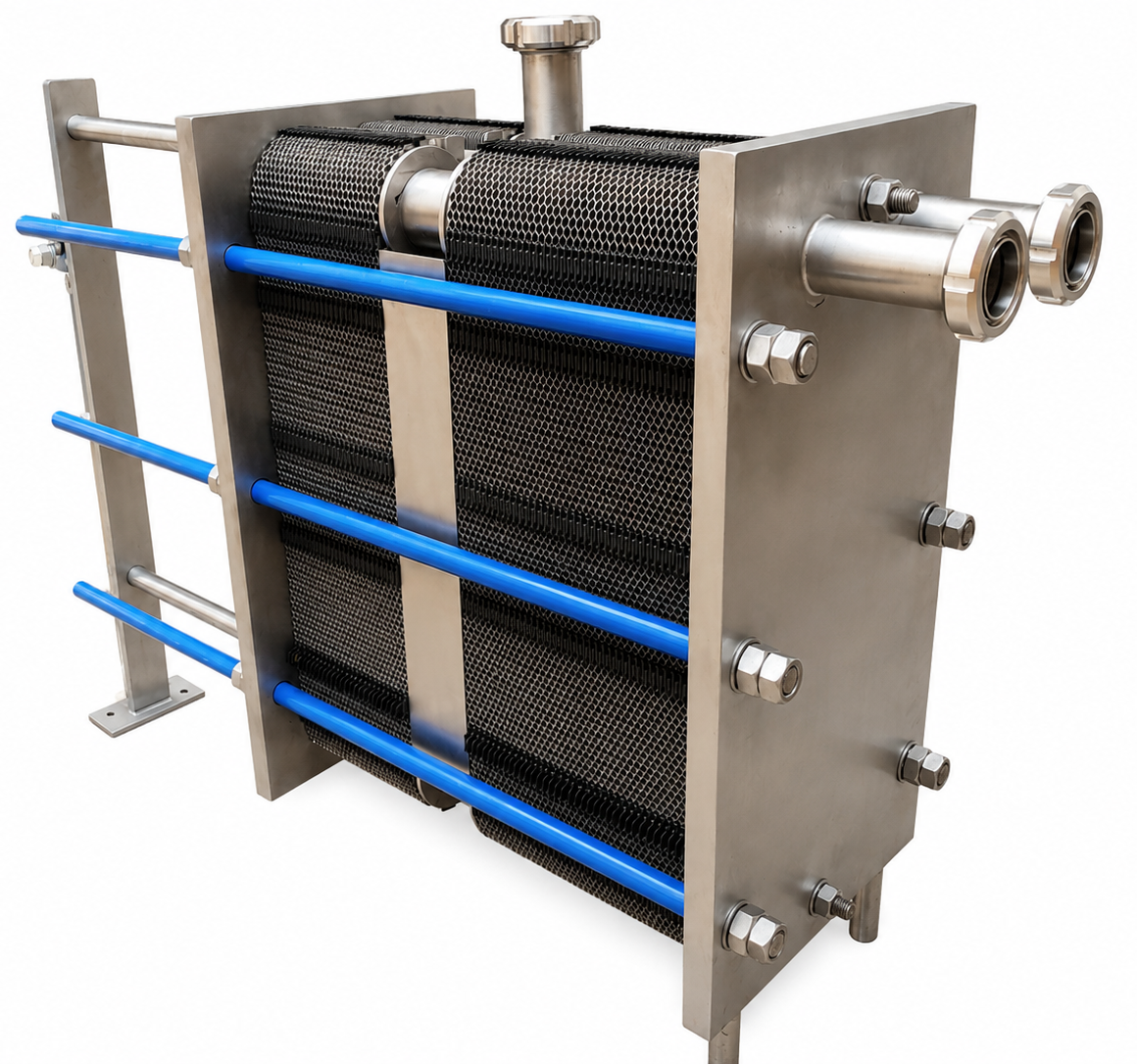
Food Grade PHE
Hygienic Heat Transfer Solutions for Food, Dairy, Beverage & Pharma Industries
When it comes to processing anything meant for human consumption, there is very little room for error. A single point of cross-contamination, a poorly sealed gasket, or an inefficient heat transfer system can compromise an entire production batch. This is exactly why industries dealing with milk, juices, pharmaceuticals, edible oils and beverages rely on equipment that is purpose-built for sanitary conditions — not general-purpose machinery adapted to fit.
PHE INDIA™ (Process Engineers And Associates) has spent more than three decades solving this exact problem. Since 1995, we have been designing, manufacturing and supplying Food Grade Plate Heat Exchangers that combine hygienic construction with genuine thermal performance. Our equipment is trusted by dairies, breweries, beverage plants, pharmaceutical manufacturers and edible oil processors across India and in international markets, precisely because it is engineered around the realities of sanitary processing rather than borrowed from industrial cooling applications.
A Food Grade Plate Heat Exchanger from PHE INDIA™ isn’t simply a scaled-down industrial unit with a few cosmetic changes. Every plate, gasket, frame and connection is selected and configured with hygiene, corrosion resistance and cleanability as the starting point of the design — not an afterthought.
What Makes a Plate Heat Exchanger "Food Grade"
A standard plate heat exchanger transfers heat between two fluids through a series of thin, corrugated metal plates, keeping the fluids physically separated while maximizing the surface area available for heat exchange. A food grade version takes this same core principle and rebuilds it around three non-negotiable requirements: material purity, cleanability, and zero cross-contamination risk.
Material selection. Our food grade units are manufactured using SS304 or SS316L stainless steel — grades chosen specifically for their corrosion resistance, non-reactive surface and ability to withstand repeated exposure to cleaning chemicals, high temperatures and acidic or high-fat food products. SS316L, in particular, is preferred for applications involving higher chloride exposure or more aggressive cleaning cycles, such as those found in dairy and pharmaceutical plants.
Gasket integrity. The gaskets used to seal each plate are made from FDA-approved, food-grade elastomers designed to maintain their sealing properties across a wide temperature range without degrading, cracking or harbouring bacteria. A compromised gasket is one of the most common failure points in hygienic processing equipment, which is why our gasket profiles are engineered for a secure, leak-proof fit that holds up over years of thermal cycling.
Plate corrugation pattern. The herringbone or chevron pattern pressed into each plate isn’t just about surface area — it’s engineered to create turbulent flow at relatively low velocities, which improves the heat transfer coefficient while simultaneously making the plate surfaces self-cleaning during CIP cycles. Poor plate design leaves stagnant zones where product can settle and bacteria can grow; our corrugation profiles are designed to minimize exactly that risk.
Frame and connection design. Food grade frames are designed to allow full plate-pack access for inspection and plate replacement, with connections sized and positioned to avoid dead legs — sections of piping where product can sit stagnant and become a hygiene risk.
Built on 30+ Years of Engineering Experience
PHE INDIA™ was founded in 1995 with a clear focus: build heat exchange equipment that Indian manufacturers could rely on without having to import expensive foreign units or compromise on hygiene standards. Over the following three decades, that focus has expanded into a full engineering capability covering both industrial and food grade plate heat exchangers, backed by an experienced technical team that understands the specific demands of sanitary processing.
Our engineering approach starts with understanding the actual process — not just quoting a standard catalogue model. Before recommending a configuration, we look at:
- The nature of the product being processed (viscosity, fat content, particulate matter, pH level)
- Required flow rate and expected variation in demand
- Operating temperature range and required temperature approach
- Available pressure drop and pumping capacity
- Frequency and method of cleaning (manual, semi-automatic or fully automated CIP)
- Space constraints at the installation site
This process-first approach means the plate count, plate pattern, gasket material, connection size and frame type are all selected to match the actual application — not adjusted after the fact to compensate for an ill-fitting standard unit. It’s this attention to the engineering detail, rather than simply supplying a generic exchanger, that has built our reputation among dairy processors, beverage manufacturers and pharmaceutical companies over the years.
Key Features of PHE INDIA™ Food Grade Plate Heat Exchangers
Hygienic construction throughout. Every food-contact surface is polished stainless steel, free from crevices, sharp internal corners or stagnant zones where residue could accumulate.
FDA-approved gasket materials. Sealing components are selected for food safety compliance and long-term thermal and chemical stability.
Clean-In-Place (CIP) compatibility. Our units are designed to integrate directly into automated or semi-automated CIP systems, allowing thorough internal cleaning without dismantling the plate pack — a critical requirement for plants running multiple product changeovers per day.
High thermal efficiency. The corrugated plate geometry creates turbulent flow even at moderate velocities, significantly improving the heat transfer coefficient compared to shell-and-tube designs of a similar footprint.
Compact, modular footprint. Plate heat exchangers occupy a fraction of the floor space required by equivalent shell-and-tube units, and additional plates can be added to the pack later if capacity requirements grow.
Corrosion and fatigue resistance. SS304/SS316L construction, combined with proper plate thickness and pressing technique, ensures the unit withstands years of thermal cycling and CIP chemical exposure without premature failure.
Easy inspection and maintenance. The frame design allows the plate pack to be opened for visual inspection, gasket replacement or plate cleaning without specialized tools or excessive downtime.
Customizable configuration. Available in a range of plate sizes, port configurations and frame materials to match capacity requirements from small batch operations to large continuous processing lines.
Industry Applications
Food Grade Plate Heat Exchangers from PHE INDIA™ are used across a wide range of sanitary processing applications, including:
- Milk chilling — rapid cooling of raw milk immediately after collection to slow bacterial growth and preserve quality before further processing
- Milk pasteurizer plate packs — precise heating and holding for HTST (High Temperature Short Time) pasteurization systems
- Yogurt and cheese production — controlled heating and cooling stages required during fermentation and setting processes
- Juice and beverage processing — pre-heating, pasteurization and post-process cooling of fruit juices, soft drinks and flavoured beverages
- Ice cream mix cooling — bringing mix temperatures down efficiently before ageing and freezing stages
- Sugar syrup cooling — used in confectionery, beverage and food manufacturing processes
- Beer and wine cooling — wort cooling in brewing operations and temperature control during fermentation
- CIP solution heating — maintaining cleaning solution at the correct temperature for effective sanitation cycles
- Hot water generation for pharmaceutical processes — supporting WFI (Water for Injection) systems and other pharma utility requirements
- Edible oil processing — heating and cooling stages in refining and packaging operations
Whichever application applies to your operation, our engineering team can recommend a plate configuration designed around your specific temperature, flow rate and hygiene requirements.
Why Food Processors and Dairies Choose PHE INDIA™
Three decades of manufacturing experience. Since 1995, we have built a track record across India and international markets, supplying equipment that continues to perform reliably years after installation.
Genuine engineering input, not just a catalogue sale. Our technical team works directly with clients to understand process parameters before recommending a configuration, rather than pushing a standard model regardless of fit.
Strict quality control. Every unit undergoes testing before dispatch to confirm sealing integrity, plate alignment and overall build quality.
Responsive technical support. From initial selection through installation and ongoing operation, our team remains available to assist with technical queries, spare parts and servicing.
Competitive pricing without compromising material quality. We manufacture in-house, allowing us to offer SS304/SS316L construction and FDA-approved gaskets at pricing that remains competitive against both domestic and imported alternatives.
Standard and custom options. Whether your requirement is a standard capacity unit available for quick delivery or a fully engineered custom solution, we can accommodate both.
Installation, Maintenance and Long-Term Reliability
Buying the right Food Grade Plate Heat Exchanger is only half the equation — how it is installed, operated and maintained determines whether it delivers consistent performance for ten years or needs premature replacement in three.
Installation considerations. Proper installation involves more than bolting the unit into place. Piping should be sized to avoid unnecessary pressure drop, isolation valves should be positioned to allow the exchanger to be taken offline for cleaning or plate inspection without disrupting the entire line, and adequate space should be left around the frame to allow the plate pack to be opened during servicing. Our engineering team can advise on layout requirements during the planning stage to avoid costly rework later.
Routine maintenance. Food grade plate heat exchangers benefit from a simple but consistent maintenance routine: periodic visual inspection of gaskets for wear or hardening, monitoring of pressure drop across the unit (a rising pressure drop often indicates fouling or plate blockage), and adherence to a regular CIP schedule appropriate to the product being processed. Because our frame design allows full plate-pack access, these inspections can typically be carried out by in-house maintenance staff without needing specialized external service visits.
Gasket replacement cycles. Gaskets are a wear component and, depending on operating temperature, product type and CIP chemical concentration, will eventually need replacement. Using FDA-approved gasket materials from the outset — as we do across all our food grade units — extends this replacement interval considerably compared to lower-grade elastomers.
Scaling for future capacity. One advantage of plate heat exchanger construction is that the plate pack can often be expanded later by adding plates, rather than requiring a completely new unit if production capacity increases. This makes it a practical long-term investment for growing operations, since initial capital expenditure can be matched closely to current requirements without closing the door on future expansion.
Working with our technical team. From the point of enquiry through installation and years of subsequent operation, our team remains available to answer technical questions, advise on spare parts, and assist with troubleshooting. This ongoing relationship is part of why so many of our clients return to PHE INDIA™ when expanding capacity or setting up new production lines.
Frequently Asked Questions (FAQ)
It is a hygienic heat transfer system designed for food, dairy, beverage and pharmaceutical industries. It uses a series of stainless steel plates to transfer heat between two fluids while keeping them completely separated, preventing any contamination between the process streams.
They are widely used in dairy processing, beverage and juice manufacturing, breweries, edible oil plants, pharmaceutical production, ice cream manufacturing and other sanitary process industries.
Our units are manufactured using SS304 or SS316L stainless steel plates along with FDA-approved food-grade gasket materials, chosen for their corrosion resistance and long-term hygienic performance.
Yes. Our Food Grade PHEs are fully compatible with Clean-In-Place systems, allowing efficient internal cleaning without dismantling the plate pack, which helps maintain consistent hygiene standards between production runs.
Yes. We design and manufacture customized units based on your processing capacity, operating temperature, pressure requirements, product characteristics and specific industry needs.
Benefits include high thermal efficiency, hygienic and contamination-free operation, a compact footprint, lower energy consumption compared to alternative heat exchanger types, easier cleaning, reduced maintenance requirements and a long operational life.
While both use the same underlying plate heat transfer principle, Food Grade PHEs use FDA-approved gasket materials, are built with hygienic surface finishes to prevent product residue build-up, and are specifically designed for CIP compatibility — requirements that are not always necessary in general industrial cooling applications.
With over 30 years of manufacturing experience since 1995, PHE INDIA™ offers premium-quality construction, genuine engineering customization, strict quality control, responsive technical support and competitive pricing to customers across India and overseas.
Simply reach out to PHE INDIA™ through our website, phone or email with your application details — required capacity, operating conditions and product information — and our technical team will recommend a suitable configuration along with a competitive quotation.