
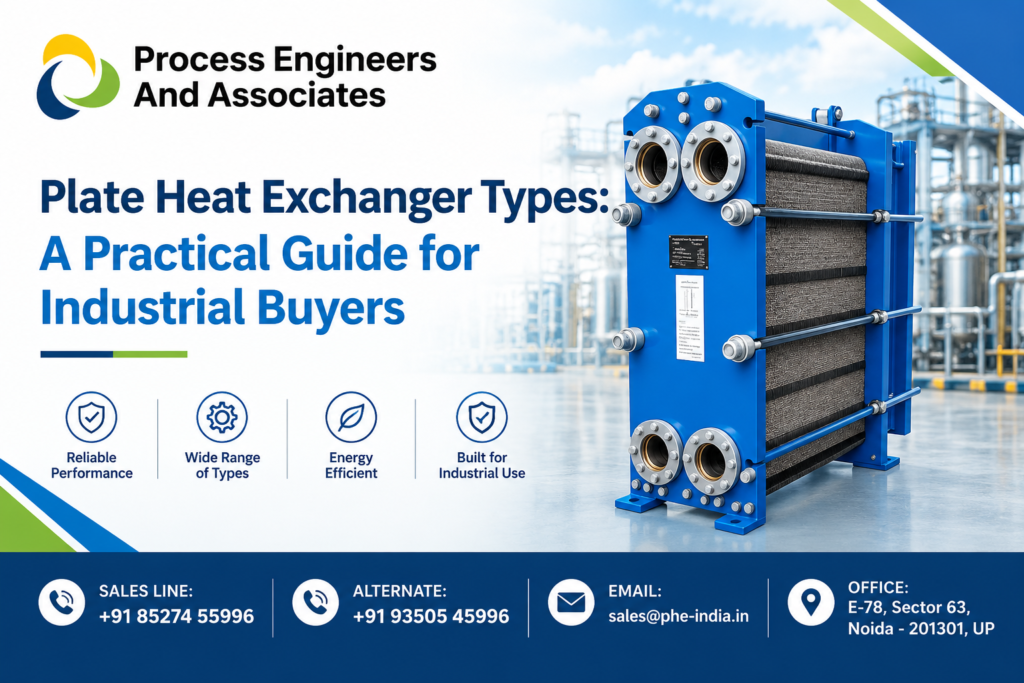
Choosing a heat exchanger for industrial heating, cooling or heat recovery is rarely a simple capacity match. Every process brings its own temperatures, pressures, flow rates, fluid chemistry, fouling conditions, space limits and maintenance expectations. Picking equipment on price or nominal capacity alone can lead to premature gasket failure, frequent cleaning or poor thermal performance.
Understanding Plate heat exchanger types is the first step toward a better decision. No single design suits every duty, so the right configuration depends on the process, not on which model is most common.
| Type | Core idea | Typical consideration |
| Gasketed | Removable plates sealed by gaskets | Serviceability, gasket compatibility |
| Brazed | Plates joined permanently by brazing | Compactness, no opening for cleaning |
| Welded | Plates joined by welding | Demanding fluids, specialized engineering |
| Semi-welded | Welded pairs plus gasketed sections | Mixed duties on each side |
| Wide-gap | Wider flow passages | Solids, fibres, fouling fluids |
What Is a Plate Heat Exchanger?
A plate heat exchanger (PHE) uses a stack of corrugated metal plates that form separate channels. A hot stream flows through some channels and a cold stream through the others. Heat passes through the plates, and under normal operation the two fluids do not mix.
This makes the design useful for heating, cooling and heat recovery. In suitable applications it can offer high heat-transfer coefficients, a smaller footprint, closer temperature approaches and easier maintenance access than traditional shell-and-tube designs. That does not make it universally superior, which the comparison below covers.
Why Are Different Plate Heat Exchanger Designs Needed?
Industrial duties differ widely. The main variables are:
- Pressure and temperature
- Fluid compatibility and corrosiveness
- Viscosity and flow rate
- Fouling and particulates
- Cleaning requirements and maintenance access
- Installation space
A clean water-to-water duty and a fluid carrying suspended solids place very different demands on plate spacing, materials and sealing. Different constructions exist so the exchanger can be matched to real operating conditions.
Major Plate Heat Exchanger Types for Industrial Applications
The types below are general industry configurations. They are not a statement of what any one manufacturer supplies.
Gasketed Plate Heat Exchangers
Here a removable plate pack sits between frame plates, with gaskets sealing each plate. The pack can be opened for inspection and cleaning, and plates can often be added or removed to adjust capacity in suitable designs. Common uses include oil cooling, HVAC and water-side heating and cooling.
Gasket selection matters because the elastomer must tolerate the fluid and the temperature. PHE INDIA™ offers EPDM, NBR and Viton gaskets for its industrial range, chosen for chemical compatibility and temperature. No single gasket suits every application.
Brazed Plate Heat Exchangers
Plates are joined by brazing instead of gaskets, creating a sealed, compact unit. Typical advantages are a small footprint and no gasket replacement. The trade-off is that the unit generally cannot be opened for mechanical cleaning, so suitability depends on pressure, temperature, fluid cleanliness and maintenance approach.
Welded Plate Heat Exchangers
Welded construction may be considered where gasketed designs are not appropriate, such as higher-temperature duties or aggressive fluids, since it reduces dependence on elastomer gaskets. These units need careful engineering and material selection, and ratings should always be confirmed for the specific duty.
Semi-Welded Plate Heat Exchangers
This design pairs welded plate cassettes with gasketed sections. It can suit duties where one fluid needs greater resistance to harsh conditions while the other side stays serviceable. It is a specialist option, not a general-purpose one.
Wide-Gap Plate Heat Exchangers
Wider flow passages help with fluids containing suspended solids, fibres or higher fouling potential, including some wastewater and process streams. Plate spacing and channel design influence fouling, pressure drop and cleaning, so the gap should be matched to the fluid.
How to Choose the Right Plate Heat Exchanger Type
Evaluate the whole process, not just exchanger size.
- Process fluid: composition, corrosiveness, viscosity, pH and suspended particles.
- Operating temperature: inlet, outlet, maximum and expected fluctuations.
- Operating pressure: normal working pressure and possible surges.
- Flow rate: normal and peak operation.
- Fouling potential: scaling, deposits or particulates affect plate spacing and cleaning.
- Material compatibility: plates and gaskets must suit the actual fluid.
- Installation space: compactness matters for retrofits and tight plant layouts.
- Maintenance: consider access for inspection, cleaning and gasket replacement.
Plate Materials and Gasket Selection
Material choice should come from actual process data, not assumptions. PHE INDIA™ lists SS304, SS316 and titanium plate options.
- SS304: a common stainless option for many general industrial duties, though not suited to every fluid.
- SS316: may be considered where more corrosion resistance is needed, depending on the fluid.
- Titanium: used in demanding environments such as seawater, chloride-rich fluids and highly corrosive chemical streams.
Gaskets follow the same logic. EPDM, NBR and Viton differ in chemical and temperature behaviour, so the fluid and operating temperature decide which is appropriate.
Industrial Applications of Plate Heat Exchangers
Industrial plate heat exchanger applications include:
- Hydraulic oil, gear oil and quench oil cooling
- Induction furnace DM-water cooling
- Wastewater heat recovery and chilled-water systems
- Automobile paint-shop process heating
- Cable and tube plant cooling
- Vegetable-oil heating
- HVAC, power generation, marine cooling, textile processing, and pulp and paper
- Solar thermal applications
Not every configuration suits every application. Each duty still needs its own evaluation.
Plate Heat Exchanger vs Shell & Tube Heat Exchanger
| Factor | Plate Heat Exchanger | Shell & Tube |
| Footprint | Often compact | Generally larger for comparable duties |
| Heat transfer | High in suitable applications | Effective across many applications |
| Maintenance | Plate packs can offer convenient access in suitable designs | Tube-bundle maintenance can be more involved |
| Expansion | Extra plates may be possible in suitable designs | Expansion approach differs |
| High pressure/temperature | Application-dependent | Can be advantageous in certain extreme conditions |
Shell-and-tube units remain relevant for some high-pressure, high-temperature and particulate-heavy duties. Neither technology is always better.
Common Mistakes Industrial Buyers Should Avoid
- Selecting only by price
- Ignoring fluid chemistry or choosing the wrong gasket material
- Underestimating fouling
- Overlooking pressure fluctuations
- Ignoring maintenance access and available space
- Supplying incomplete operating data
- Using a standard configuration for a non-standard process
Accurate process information helps the manufacturer size and configure the unit properly.
Why Process-Specific Engineering Matters
An exchanger that works well in one plant may struggle in another. Fluid characteristics, temperature, pressure, flow rate, fouling tendency and installation constraints all shape the right design. PHE INDIA™ describes its approach as process-first engineering rather than supplying a generic unit without considering the application.
Why Choose PHE INDIA™ for Industrial Plate Heat Exchangers?
Based on the company’s Industrial Plate Heat Exchanger page, PHE INDIA™ (Process Engineers And Associates) offers:
- Manufacturing experience dating back to 1995
- Applications across chemical processing, power generation, HVAC, water treatment, marine and heavy manufacturing
- SS304, SS316 and titanium plate options
- EPDM, NBR and Viton gasket options
- Pressure and leak testing before dispatch
- Standard and customized solutions
- Technical support, spare parts and servicing guidance
What Information Should You Provide When Requesting a Quote?
| Category | Details to share |
| Fluids | Name and properties of both fluids |
| Temperatures | Inlet and required outlet temperatures |
| Flow and duty | Flow rate and required heat-transfer duty |
| Pressure | Operating and design pressure |
| Condition | Fouling information |
| Site | Available space and connection requirements |
| Materials | Preferences, if known |
Complete data lets the engineering team recommend a more suitable configuration.
Frequently Asked Questions
1. What are the main plate heat exchanger types?
The common configurations are gasketed, brazed, welded, semi-welded and wide-gap designs.
2. Which type is easiest to maintain?
Gasketed units can be opened for inspection and cleaning, which is why many buyers consider them for serviceability.
3. Are plate heat exchangers better than shell-and-tube units?
Not always. They suit many duties, but some high-pressure, high-temperature or particulate-heavy applications may favour shell-and-tube designs.
4. How do I choose plate and gasket materials?
Base the choice on fluid chemistry and operating temperature, and confirm with the manufacturer.
5. What data is needed for a quotation?
Fluid details, temperatures, flow rate, pressure, fouling information, duty and installation space.
Conclusion
The right exchanger comes from weighing configuration, fluid characteristics, temperature, pressure, flow rate, fouling, plate and gasket materials, maintenance and installation requirements together. Select the design your actual process needs rather than simply the most common one.
If you are evaluating a plate heat exchanger for an industrial heating, cooling or heat-recovery application, share your process requirements with PHE INDIA™ to discuss a suitable configuration.You can Contact us to know more about our products.