
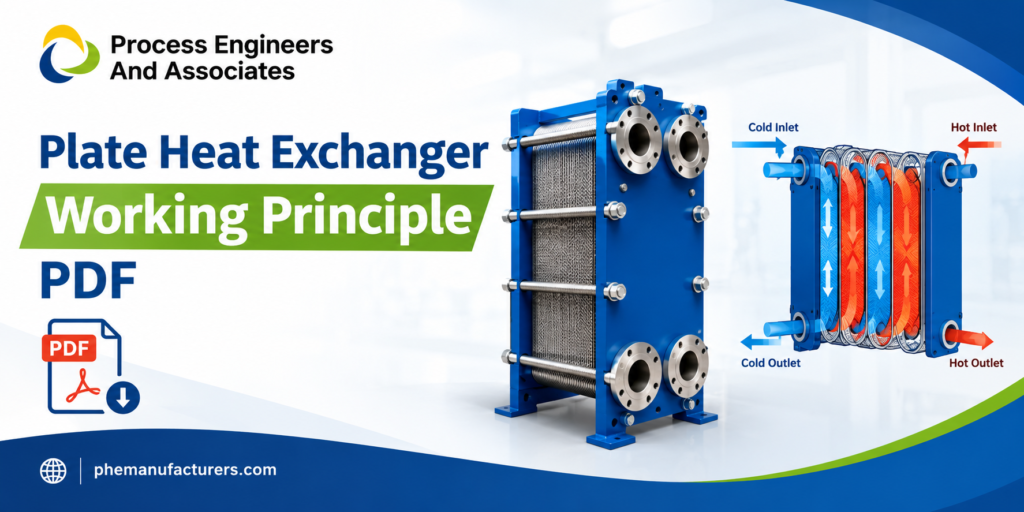
Plate heat exchangers (PHEs) move heat between two fluids in dairy plants, steel mills, pharmaceutical units, HVAC systems and many other industries. They are compact, efficient and easy to service. Knowing how they work helps you select the right unit, run it properly and spot problems early.
If you are looking for a Plate Heat Exchanger Working Principle PDF, this guide covers what such a document should contain: the flow path, the components, the heat-transfer fundamentals, the exchanger types and the maintenance basics.
Quick answer: A plate heat exchanger works by passing a hot fluid and a cold fluid through alternate channels formed between thin, corrugated metal plates. Heat flows through the plates from the hotter fluid to the colder one. The two fluids do not mix during normal operation.
What Is a Plate Heat Exchanger?
A plate heat exchanger is a device that transfers heat between two fluids through a stack of thin, usually metal, heat-transfer plates. This is indirect heat transfer, because the fluids never touch. Only the plate wall separates them.
Each plate is pressed with a corrugated pattern. Together, the plates provide a large heat-transfer area in a small footprint. Under normal operating conditions, the plates and gaskets keep the two fluids on separate sides.
Plate Heat Exchanger Working Principle Explained
This is how a typical gasketed unit works, step by step:
- The hot fluid enters through its designated inlet port on the frame.
- The cold fluid enters through a separate inlet port.
- The plate arrangement directs each fluid into alternating channels. Gaskets and port openings ensure hot fluid fills every other gap and cold fluid fills the gaps in between.
- Heat transfers through the plate walls from the hotter fluid to the colder one.
- The corrugated surface promotes turbulence. The pattern forces fluid to change direction constantly, which disturbs the stagnant boundary layer at the wall and typically improves heat transfer.
- Both fluids exit through their own outlets at changed temperatures: the hot fluid cooler, the cold fluid warmer.
Counter-Current Flow
In most PHE duties, the two fluids flow in opposite directions. This is called counter-current heat transfer. It keeps a useful temperature difference along the whole plate length. It can also let the cold fluid leave warmer than the hot fluid’s outlet temperature, which is not possible in parallel flow.
The actual flow arrangement (single-pass, multi-pass, parallel or counter-current) depends on the exchanger design and the application.
Plate Heat Exchanger Diagram and Flow Path
A good plate heat exchanger diagram shows the flow clearly. Here is the brief for the diagram to publish with this article:
- Layout: An exploded or cut-away view of a gasketed PHE, with the fixed frame plate on the left, the plate pack in the centre and the movable pressure plate on the right.
- Colours: Red arrows for the hot-fluid path and blue arrows for the cold-fluid path, shown in alternating channels.
- Labels: Hot inlet, hot outlet, cold inlet, cold outlet, heat-transfer plates, gaskets, frame, carrying bar and tightening bolts.
- Consistency: The port positions and flow directions must match the counter-current arrangement described above.
Suggested caption: “Flow path in a gasketed plate heat exchanger: hot and cold fluids pass through alternate plate channels, separated by thin heat-transfer plates.”
Alt text: “Plate heat exchanger working principle diagram showing separate hot and cold fluid channels.”
Main Components of a Plate Heat Exchanger
| Component | Purpose |
| Heat-transfer plates | Thin corrugated plates that carry heat from one fluid to the other and create turbulence |
| Plate pack | The assembled stack of plates that forms the alternating hot and cold channels |
| Gaskets | Seal the plate edges and ports, and direct each fluid into its intended channels |
| Fixed frame plate | The stationary end plate that usually carries the connections |
| Movable pressure plate | The end plate that compresses the plate pack |
| Carrying bar and guide bar | Support and align the plates and allow the pack to be opened and re-closed |
| Tightening bolts | Compress the plate pack to the manufacturer’s specified condition |
| Inlet and outlet connections | Bring fluids into and out of the unit |
Component arrangements vary by model and construction type, so always check the manufacturer’s drawings for your unit.
How Heat Transfer Takes Place
Three mechanisms act in series:
- Convection from the hot fluid to the plate surface.
- Conduction through the metal plate.
- Convection from the plate surface to the cold fluid.
The overall heat-transfer rate is commonly estimated with:
Types of Plate Heat Exchangers
| Type | Construction | Serviceability | Selection considerations |
| Gasketed | Plates sealed with gaskets, held in a bolted frame | Can be opened for inspection, cleaning and plate changes | Gasket and plate material must suit the fluids, temperature and pressure; capacity can often be adjusted by adding plates |
| Brazed | Plates joined by brazing into a sealed unit | Cannot be opened; cleaned by flushing or chemical methods | Compact; suited to clean fluids and limits set by the brazing material |
| Welded | Plates welded into cassettes or a full pack | Limited mechanical access | Considered for demanding fluids or conditions where gaskets are unsuitable |
| Semi-welded | Welded plate pairs with gaskets between pairs | Partly accessible | Often considered where one fluid is aggressive and the other is not |
Not every type suits every application. The right choice depends on fluids, temperature, pressure, cleanability and budget. Based on its website, PHE INDIA™ presents gasketed plate heat exchangers, in industrial and food-grade versions. Confirm other types with the company before specifying them.
Industrial Applications of Plate Heat Exchangers
Plate heat exchanger applications span many sectors:
- Dairy and food processing: milk cooling, pasteurisation and heating.
- Beverages: instant cooling before carbonation and sugar syrup cooling.
- Pharmaceutical manufacturing: hot water generation and chemical cooling.
- Chemical processing: process heating and cooling, where plate material compatibility is critical.
- HVAC and chilled-water systems: isolating chiller water from process water.
- Hydraulic and lubrication oil cooling: keeping oil within its operating temperature range.
- Steel plants and induction furnaces: cooling furnace bodies and induction heaters.
- Wastewater treatment: recovering heat from effluent.
- General industrial heating and cooling: quench baths, wire drawing coolants and electroplating lines.
Five factors shape selection in every case: temperature range, fluid properties, operating pressure, hygiene requirements and fouling behaviour. A milk pasteuriser needs sanitary materials and cleanability. A furnace-cooling loop needs reliable heat removal with treated water. The right unit differs for each.
Advantages of Plate Heat Exchangers
- High heat-transfer performance because of turbulent flow and thin plates.
- Compact footprint compared with many other exchanger types for similar duties.
- Efficient energy use, since close temperature approaches are often achievable.
- Flexible capacity in suitable gasketed designs, where plates can sometimes be added or removed.
- Accessible plates for inspection and cleaning.
- Potential reduction in operating costs through energy savings and easier servicing.
These benefits are not automatic. Real plate heat exchanger efficiency depends on correct sizing, suitable fluids, operating conditions and maintenance.
Factors Affecting Plate Heat Exchanger Performance
- Inlet and outlet temperatures: these set the available temperature difference and the required duty.
- Flow rates and fluid properties: viscosity, density, specific heat and thermal conductivity all affect turbulence and heat transfer.
- Plate geometry and effective area: plate pattern and plate count influence both thermal performance and pressure drop.
- Flow arrangement: counter-current flow generally uses the temperature difference most effectively.
- Pressure drop: more turbulence usually improves heat transfer but increases pumping energy, so design balances the two.
- Material compatibility: plate and gasket materials must resist the fluids, temperatures and cleaning agents they will meet.
- Scaling and fouling: deposits add thermal resistance, reduce U and can restrict flow.
- Pressure and temperature limits: operating outside the design limits can damage gaskets and plates and shorten service life.
Plate Heat Exchanger Maintenance and Troubleshooting
Watch for these warning signs:
- Reduced thermal performance: outlet temperatures drifting from normal.
- Rising pressure drop: often a sign of fouling or blocked channels.
- External leakage: commonly linked to gasket condition, alignment or compression.
- Suspected internal crossover: mixing between fluids, which needs prompt investigation.
- Scaling or fouling: visible deposits or declining performance.
Good plate heat exchanger maintenance includes suitable cleaning procedures, gasket inspection, plate condition checks and following the manufacturer’s operating and maintenance instructions. Cleaning chemicals, tightening dimensions and operating limits are model- and material-specific, so take them from the manufacturer’s documentation rather than general rules. PHE INDIA™ has a dedicated plate heat exchanger maintenance page that is a useful starting point.
What to Look for in a Plate Heat Exchanger Working Principle PDF
A plate heat exchanger technical guide PDF is only useful if it is clear and complete. Check that it includes:
- A labelled working-principle diagram.
- Descriptions of each component.
- Clear hot- and cold-fluid flow paths.
- Heat-transfer fundamentals (convection, conduction, LMTD).
- Basic sizing terminology.
- Maintenance and safety guidance.
- Relevant technical specifications, with the source and revision date.
Be cautious of PDFs with no author or source, generic stock diagrams that do not match the text, or unexplained performance figures.
PHE INDIA™ does not currently offer a downloadable working-principle PDF on its website. It does offer inquiry sheets for sharing technical data on new PHE designs and for identifying an existing PHE model, which are linked on the homepage. This article is designed to give you the same core content in one place.
Why Choose PHE INDIA™ for Plate Heat Exchanger Solutions?
PHE INDIA™ (Process Engineers And Associates) is a plate heat exchanger manufacturer and supplier based in Noida, Uttar Pradesh, and has been manufacturing plate heat exchangers since 1995, according to its website. It offers industrial PHEs and food-grade PHEs, with food-grade units described as using SS304 and SS316L stainless steel and food-grade gasket materials.
The company states that it customises units to process requirements and supports customers from requirement analysis through application engineering, manufacturing, testing, installation support and after-sales service. It also supplies PHE plates, gaskets and spare parts, and offers an online sizing calculator.
Whichever supplier you consider, base the selection on your own fluids, temperatures, pressures and cleaning needs. To discuss your application, use the contact page.
Frequently Asked Questions
What is the working principle of a plate heat exchanger?
A plate heat exchanger passes hot and cold fluids through alternate channels between thin corrugated plates. Heat conducts through the plate walls from the hotter fluid to the colder one. The fluids stay separate, and the corrugations create turbulence that improves heat transfer.
How does a plate heat exchanger work?
Each fluid enters through its own port and is directed by gaskets into alternate plate channels. As the fluids flow past each other, heat moves through the plates. Both fluids then leave through separate outlets, with the hot fluid cooler and the cold fluid warmer.
Why is counter-current flow commonly used?
Counter-current flow keeps a more uniform temperature difference along the plates. This allows closer temperature approaches and generally better use of the heat-transfer area than parallel flow. The final arrangement still depends on the exchanger design and the duty.
Do the two fluids mix inside a plate heat exchanger?
Not during normal operation. Plates and gaskets keep the fluids apart. Mixing can occur if a plate is damaged or a seal fails, so suspected crossover should be investigated and corrected promptly.
What affects plate heat exchanger efficiency?
Efficiency depends on temperatures, flow rates, fluid properties, plate geometry, flow arrangement, pressure drop and fouling. Correct sizing, compatible materials and regular maintenance also matter. No single figure applies to all units, because performance is specific to each design and duty.
Conclusion
The plate heat exchanger working principle is simple: two fluids flow through alternating channels, and heat passes through thin corrugated plates from the hotter fluid to the colder one. The plates provide the heat-transfer area, the gaskets and flow channels keep the fluids separate, and turbulence helps the heat move efficiently.
Appropriate sizing, material compatibility and regular maintenance keep that performance reliable over time. A good plate heat exchanger working principle PDF should explain these ideas clearly, and this guide aims to do the same.
If you need an application-specific solution, contact PHE INDIA™ with your process conditions for technical guidance
Contact Us : – https://phemanufacturers.com/contact-us/